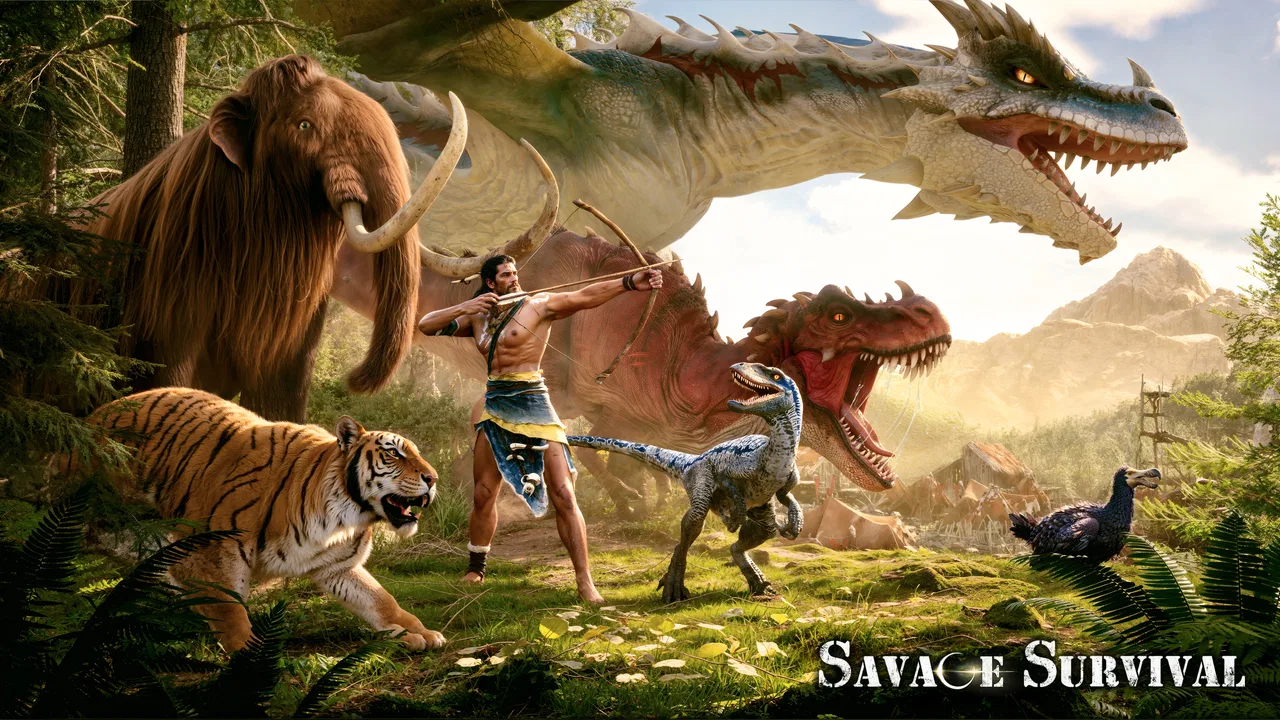
Savage Survival:Jurassic Isle
- 4.5
- Rating
- 5.00M
- Installs
- Free
- Price

 Analysis by App-foxy
I approached Savage Survival:Jurassic Isle expecting a strategy game with a prehistoric setting, but its real appeal is the pressure of making sensible choices while trying to stay alive. Phantix Games presents it as a free game for Android, and I found the experience most interesting when I treated every decision as a trade-off rather than simply chasing the biggest reward. The dinosaur theme gets attention first, yet the lasting hook is the survival mindset: protect what matters, judge risks carefully, and avoid wasting resources on actions that look exciting but leave you exposed.
This is a useful game to consider if you enjoy strategy experiences built around gradual progress, danger, and planning rather than quick matches. It is aimed at a Teen audience, and that feels appropriate for the survival tone and prehistoric threats. The game was released on May 30, 2024, and the current version is 1.3.771. It has already passed one million installs and holds a 4.5 average from around 32 thousand ratings, which suggests that the basic concept connects with a sizeable audience.
What to consider before choosing the island
The first question I would ask is not whether you like dinosaurs. It is whether you enjoy being interrupted by problems that need a response. Survival strategy is rarely about one brilliant move. It is about deciding what can wait, what must be handled immediately, and which improvement will help several future situations instead of solving only the current one.
You May Also Like

 Blood Strike: 2.5 Anniversary
Blood Strike’s Loadouts Turn Every Drop Into a Tactical Gamble
A close look at Blood Strike’s custom loadouts: how fast access to signature weapons reshapes its battle royale rhythm, rewards preparation, and narrows the gap between fights.

 Pandora - Music & Podcasts
Pandora’s Music Is Easy to Start, but Harder to Recover
Pandora’s strength is its low-effort path from a seed to a station. Its weak spot is how much confidence it asks you to place in connection, setup, and quiet recovery.

 8 Ball Pool
 Is Built on Rivalries, Rematches, and Routine
A close look at the rivalries, rematches, shared routines, and unanswered safety questions that turn a quick pool match into a persistent mobile community.

 Samsung Music
’s Quiet Strength Is Playing What You Already Own
Its reach comes less from spectacle than from dependable access to a personal library. That simplicity is both the app’s strongest retention engine and its ceiling.

 AccuWeather: Weather Radar
AccuWeather Review: A Quick, Clear Forecast for Everyday Decisions
For everyday plans, the best forecast is the one you can understand quickly. AccuWeather makes rain timing, radar, and local conditions easy to act on, with a few trade-offs.

 Hill Climb Racing
Why Hill Climb Racing Still Turns Crashes Into One More Run
A tiny car, a bumpy hill and one more upgrade: Hill Climb Racing keeps resurfacing because its simple chaos makes every near-miss feel personal.
More From Our News Desk



That makes the game a better match for players who like a measured pace. If you prefer a strategy title where every session has a clear finish and a clean win-or-loss result, this may feel less direct. Here, progress is more satisfying when I could see the reason behind it. A safer route, a better-prepared position, or a more careful use of supplies mattered more to me than simply tapping through the next objective.
I also paid attention to how well the game fits ordinary spare time. I could imagine opening it during a commute, after dinner, or while waiting for an appointment, but I would not recommend treating it as a completely mindless distraction. Even a short session can create a new decision to remember later. The best way to play is to leave yourself a clear next step before closing the game, such as upgrading a useful part of your setup or preparing for a more demanding encounter.
The free entry point is important. You can try the central experience without paying first, which makes the decision easier than with a premium game that asks for money before you understand its rhythm. At the same time, optional purchases range from $0.99 to $99.99 per item. I would therefore decide early whether I am comfortable progressing at my own pace or whether I am likely to feel tempted whenever progress slows.
My practical advice is to spend the opening sessions learning the economy of your decisions. Do not assume that the most visible improvement is automatically the best one. A small benefit that helps you repeatedly can be more valuable than a dramatic upgrade used only in a narrow situation. This is one of the first places where the game rewards attention rather than speed.
How the prehistoric setting changes the strategy
The Jurassic setting is not just decoration in the way I experienced it. It changes the emotional weight of exploration. A familiar fantasy battlefield can make a failed attempt feel routine, while an island filled with prehistoric danger makes preparation feel more necessary. I found myself thinking about exposure and timing before acting, especially when the reward seemed attractive enough to encourage a careless move.
That atmosphere gives the game a stronger identity than a plain resource-management title. The setting helps explain why progress can feel fragile and why a cautious player may enjoy the experience more than an impulsive one. You are not simply building toward a high score; you are trying to make your position sustainable in a place that constantly suggests that something larger and more dangerous is nearby.
Still, the theme will not rescue the game for everyone. If dinosaurs are not appealing to you, the underlying strategy needs to be strong enough to carry the experience on its own. In my view, it mostly does, but players who want a deep historical simulation or a highly competitive tactical battlefield may find the island’s survival focus less satisfying than a dedicated strategy alternative.
Where Savage Survival:Jurassic Isle works best
The strongest part of the game is the way it turns progress into a chain of connected judgments. I rarely felt that one action existed in isolation. Choosing to improve one area can affect what I am ready to handle next, and spending too freely can make the following stage feel harder than it needed to be. That relationship between present comfort and future security is the game’s most useful strategic lesson.
The best habit is to plan one problem ahead, not one reward ahead. When I focused only on what I could gain immediately, I was more likely to leave myself poorly prepared. When I considered what the next challenge might demand, even without knowing every detail, my decisions became more consistent. This is a simple change in approach, but it makes the game feel much less random.
Another strength is its accessibility. The game does not require me to understand a complicated genre vocabulary before I can begin making meaningful choices. A newcomer to strategy games can approach it through survival instincts: gather what seems useful, protect progress, and avoid taking unnecessary risks. More experienced players can look deeper into efficiency and timing without needing the game to become an intimidating spreadsheet.
I also like that the dinosaur premise creates natural variety in how players may think about the same situation. One person may prefer a conservative approach, building security before moving forward. Another may accept more danger in exchange for faster development. The game is more enjoyable when it lets you recognize your own style and then tests whether that style can handle a new pressure.
Small decisions that improve a session
One useful workflow is to begin each session by checking your immediate objective instead of acting on the first available option. I found this prevents a common mistake in survival games: using valuable resources on a convenient action, then discovering that the actual priority requires something else. A brief pause at the start can save several poor choices later.
A second tip is to separate progress from preparation. If every action is aimed at moving forward, you may reach a new situation without enough support behind you. I preferred alternating between advancement and reinforcement. This can feel slower, but it reduces the frustration of having to recover from an avoidable setback.
A third insight is to treat danger as information. When an attempt goes badly, the useful question is not only how to win next time. I ask what the failed attempt revealed about my readiness, timing, or resource use. That turns disappointment into a planning tool. The game becomes more rewarding when each mistake changes the way I approach the next decision.
For a realistic everyday example, imagine playing during a short lunch break. I would not begin a complicated push with only a few minutes available. Instead, I would review the current situation, make a low-risk improvement, and stop at a sensible point. That approach avoids returning later to a half-finished plan that requires immediate attention. The game fits short sessions better when you play with an exit plan.
What the audience response tells me
The 4.5 average and roughly 32 thousand ratings give the game a strong public reception, while more than 450 written reviews add useful evidence that people are engaging with it beyond a single download. I do not read those figures as proof that every player will enjoy it. I read them as a sign that the survival-strategy combination has enough appeal to justify trying the free version, especially if the setting already interests you.
Its one million-plus installs also make it feel like an established choice within its particular niche rather than an obscure experiment. That matters when deciding whether to invest time in a progression-based game. I felt more comfortable learning its systems because the game has attracted a substantial audience, even though popularity cannot remove the normal friction of free-to-play design.
Where another strategy game may fit better
The usual alternatives divide into several groups, and each serves a different player. City builders are often better when the pleasure comes from orderly expansion and long-term construction. Tactical battle games are a stronger choice when you want precise combat decisions, clearly defined turns, or direct competition. Idle strategy games suit people who prefer progress that continues with minimal attention. Savage Survival:Jurassic Isle sits closer to the survival-planning side, where uncertainty and preparation matter more than neat construction or purely automatic growth.
That comparison helped me identify its limits. If I want a calm building session, the prehistoric danger can feel like unnecessary pressure. If I want a fast competitive match, the survival structure may seem too gradual. If I want a completely hands-off experience, the need to think about the next step can be a drawback rather than a benefit.
Players who dislike in-app purchases should also make a deliberate choice before settling in. The game is free, but the presence of purchases from $0.99 through $99.99 means the commercial layer is part of the experience. I would not begin with the assumption that paying is required, but I would set a personal boundary before playing. That makes it easier to judge the game on its strategy instead of reacting emotionally when progress becomes less convenient.
The Teen content rating is another reason to consider your audience. It is not the obvious choice for a very young child, particularly if you are looking for a gentle, uncomplicated game. For teenagers and adults who enjoy survival themes, the rating is less of a concern. Parents should still look at the game’s purchase options before allowing unsupervised play, especially because the available item range includes a high-priced option.
There is also a switching cost in learning any alternative. Moving to a pure city builder means learning its construction priorities. Moving to a tactical game means adapting to its battle rules. Switching away from this title means giving up the particular tension created by combining a dinosaur island with survival planning. I would switch only if the central loop itself is wrong for me, not because one difficult session felt unfair.
When I would choose something else
I would choose another game if my main goal were a short, self-contained challenge with no ongoing preparation. I would also look elsewhere if I wanted a story-led adventure where exploration and character development were more important than managing risk. This game’s identity depends on the survival loop, so players who need a strong narrative reason for every action may not find enough motivation in the setting alone.
I would be cautious about recommending it to someone who becomes frustrated by slow progress or repeated recovery. Survival strategy can make setbacks meaningful, but that meaning does not automatically make them enjoyable. If you prefer constant rewards and immediate power increases, a faster arcade-strategy game may be a better match.
On the other hand, I would recommend it over a generic idle title to anyone who wants their choices to matter more. The prehistoric setting gives the decisions a clearer emotional context, and the game asks for more attention than simply collecting rewards at intervals. It is also a better fit than a highly technical strategy simulator for a player who wants planning without a steep learning barrier.
What the free model means for long-term play
Because the game costs nothing to download, the sensible approach is to use the early experience as a test of patience and decision-making. Do I enjoy preparing for the next threat? Do I like balancing improvement against safety? Am I comfortable continuing without buying anything? Those questions matter more than whether the first few minutes look attractive.
I recommend keeping purchases separate from frustration. If a difficult moment makes an item look necessary, I would close the purchase screen and return after a break. A strategy game should be judged by whether its choices are satisfying, not by how urgently it makes a shortcut appear. Setting a spending limit in advance is especially sensible here because the item range extends from small purchases to a much larger single option.
The current version, 1.3.771, is the version I would look for when installing, and Android users need at least version 5.1 of the operating system. Those details make it accessible to many older Android devices, although performance and comfort can still vary from one phone to another. I would keep enough storage and battery available for a relaxed session rather than trying to play during a moment when the phone is already struggling.
For someone wondering whether the game works offline, I would not build a decision around that assumption. Survival games often depend on their broader progression and account environment, so I would install it while connected and check how it behaves on the device I plan to use. The more important point is that the game is not ideal for people who need a guaranteed, uninterrupted experience with no dependence on ongoing progression.
How to decide after the first few sessions
After a handful of sessions, I would review three things. First, did I enjoy making cautious choices, or did I keep wishing the game would move faster? Second, did the island setting make each risk feel meaningful, or did it become background decoration? Third, did I feel proud of solving problems, or mainly relieved when the game stopped asking for attention?
If the answers are positive, the game has a good chance of becoming a comfortable regular strategy title. If the answers are negative, I would not force it simply because the rating is strong. A 4.5 average reflects broad approval, not a promise that the survival format will suit every player. The free price makes trying it low-risk, but your time is still worth protecting.
I would also watch for whether my decisions become more informed over time. Improvement should feel like learning the island’s logic, not merely waiting for enough resources to accumulate. If I can explain why a choice worked and adjust after it failed, the strategy remains engaging. If every session feels like repeating the same actions until the next unlock appears, one of the more specialized alternatives may offer better long-term value.
My recommendation for the right player
After spending time with it, I see Savage Survival:Jurassic Isle as a good recommendation for players who want approachable strategy with a survival edge and a memorable dinosaur setting. I especially recommend it to people who enjoy planning around limited options, learning from mistakes, and making progress without needing every session to end in a decisive victory.
I would recommend starting for free, resisting impulse purchases, and giving the game enough time to reveal whether its slower decisions appeal to you. Use short sessions to learn priorities, alternate advancement with preparation, and treat setbacks as clues rather than verdicts. Those habits make the experience more rewarding and help you decide fairly whether the game deserves a place on your device.
I would skip it if you want a purely relaxing builder, a rapid competitive match, or a completely hands-off idle game. I would also choose another option if the presence of in-app purchases makes you uncomfortable from the outset. For everyone else, the combination of accessible strategy, survival pressure, and Jurassic atmosphere gives this free title a clear reason to try it.
My final view is straightforward: this is best enjoyed as a thoughtful survival game, not as a button-tapping dinosaur theme park. Phantix Games has created an experience where preparation carries more weight than flashy action. It will not replace every kind of strategy game, but for the player who wants to rule a dangerous island one careful decision at a time, it is a worthwhile download.
FAQs for Savage Survival:Jurassic Isle
01What is Savage Survival: Jurassic Isle about?
Savage Survival: Jurassic Isle is an immersive survival game set on a prehistoric island teeming with dinosaurs. Players must gather resources, build shelters, and craft tools while fending off dangerous creatures. The game combines exploration, strategy, and survival elements to deliver an engaging experience in a Jurassic world.
02Is Savage Survival: Jurassic Isle free to play?
Savage Survival: Jurassic Isle offers a free-to-play model with optional in-app purchases. While you can enjoy the core experience without spending money, certain enhancements and items can be purchased to improve gameplay. This allows players to customize their experience based on preference and budget.
03What platforms is Savage Survival: Jurassic Isle available on?
Savage Survival: Jurassic Isle is available for both Android and iOS devices. It is optimized for mobile gameplay, ensuring smooth performance across a wide range of smartphones and tablets. Check the respective app stores for compatibility with your device before downloading.
04What are the main features of Savage Survival: Jurassic Isle?
The game features an expansive open world filled with diverse dinosaur species, crafting and building mechanics, and an intricate survival system. Players can team up with friends in multiplayer mode or go solo. Regular updates bring new challenges and content, keeping the gameplay fresh and engaging.
05Are there any tips for new players starting Savage Survival: Jurassic Isle?
New players should focus on gathering essential resources like wood and stone to craft basic tools and build a shelter. Pay attention to the environment and avoid dangerous areas until you're better equipped. Joining a community or alliance can provide valuable support and tips for surviving the island's challenges.
Pros
- Stunning graphics bring the Jurassic world to life.
- Intuitive controls make gameplay smooth and engaging.
- Diverse range of dinosaurs to interact with.
- Multiplayer mode adds competitive edge.
- Regular updates with new features and challenges.
Cons
- In-app purchases can be quite expensive.
- Requires a stable internet connection.
- Battery consumption is relatively high.
- Occasional lag in high-action scenes.
- Limited offline gameplay options.

Savage Survival:Jurassic Isle
Gallery